Learn
The two-account system: one account for bills, one for spending
The two-account system uses two checking accounts: one for bills, one for spending. It works because bills never touch your spending money, so what sits in the spending account is yours to use. The one thing to get right is how much moves to spending each payday, and a forecast of the bills account answers that.
How to set up two checking accounts
Setup takes an afternoon. After that, it runs on its own.
- Open a second checking account at the same bank. Transfers between two accounts at one bank are instant and free. Pick an account with no monthly fee and no minimum balance. Then rename them “Bills” and “Spending” in your bank’s app so you can’t mix them up.
- Point every autopay at the bills account. Rent, car payment, phone, insurance, streaming. Open last month’s statement and move each one, so nothing keeps drawing from the spending account. A few billers make you call to change it, which takes five minutes.
- Send your paycheck to the bills account. Point your direct deposit there. Then, on payday, move what the bills don’t need over to spending. The worked example below shows how to find that amount, and it’s not arithmetic.
Everything else comes out of the spending account: groceries, gas, coffee, a night out. You don’t have to log any of it. Track your bills, not your burritos.
One habit makes the whole thing hold: keep the bills account’s debit card in a drawer. If you never swipe it, a grocery run can’t leave rent short. The bills account only takes money in on payday and sends it out to bills.
A worked example
Say you take home $1,430 every two weeks, and the bills account has $2,400 in it today. These are the bills that come out of it every month.
| Bill | Amount | Due |
|---|---|---|
| Rent | $1,450 | the 1st |
| Netflix | $18 | the 5th |
| Phone | $70 | the 12th |
| Insurance | $140 | the 20th |
| Car payment | $385 | the 28th |
| Total | $2,063 | a month |
The old way is to add up a year of bills, divide by 26 paychecks, and transfer that into the bills account. It gets you close. But paydays drift across the calendar, and you redo the division every time a bill changes.
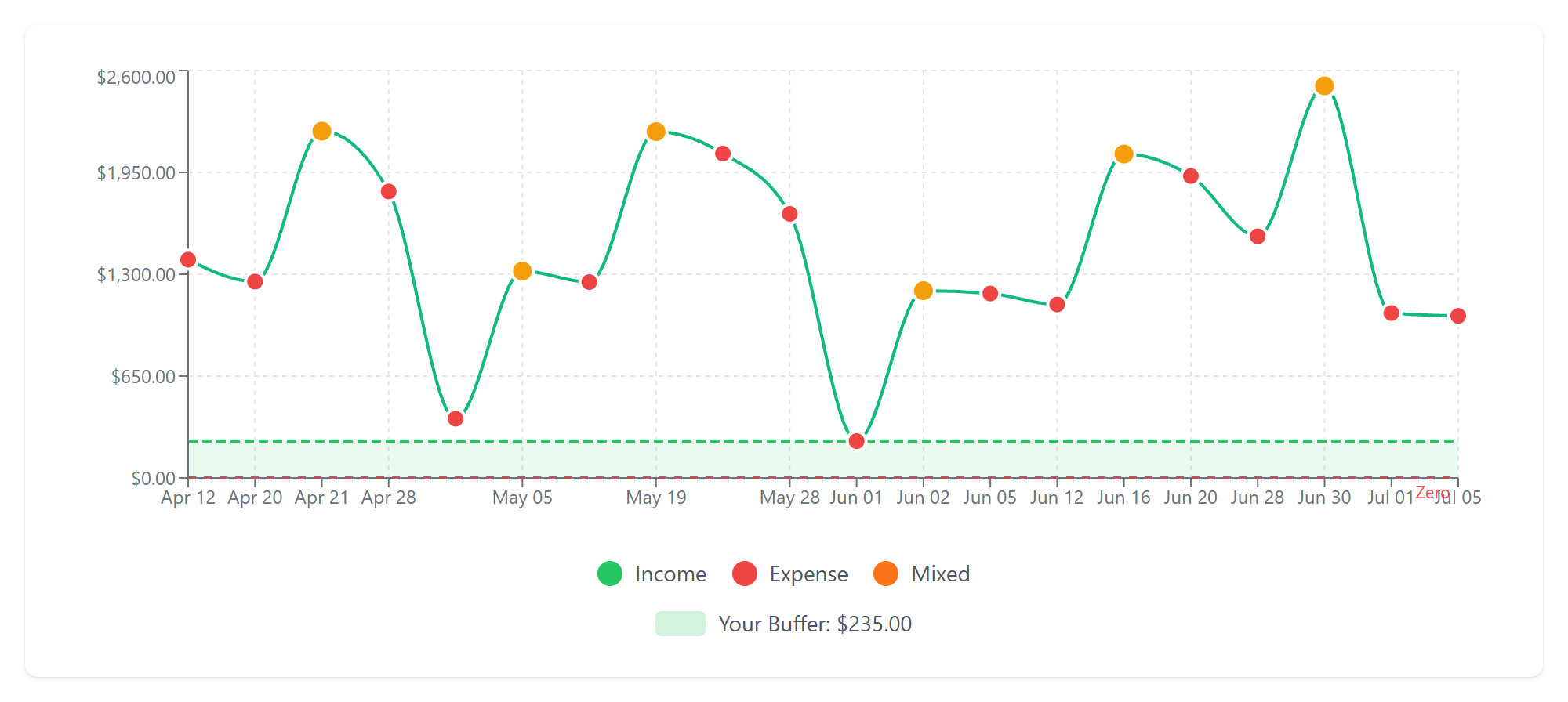
The easier way is to put it all in a forecast. Today’s balance, the paycheck as a repeating item, every bill as a repeating item. The balance forecasted forward climbs on each payday and steps down at each bill, and its lowest point is the money that’s spoken for.
Then add the transfer to spending as one more repeating item and try a number. Try $500, and in the tightest payday timing the line goes under zero on June 1, when rent lands before the second paycheck. Try $470, and the lowest point is $235 on June 1. It never goes lower across the whole year.
So $470 moves to spending each payday. That number may be smaller than your bank balance made it feel. But it’s real, and you can spend all of it without checking whether a bill is coming. The third paycheck in a three-paycheck month stays in the bills account, and the line already counts on it.
That low point is your buffer: the lowest balance you’re willing to let the bills account touch. If it sits comfortably above a few hundred dollars, raise the transfer. If it dips, trim it. When a bill changes, change that one item and look at the line again.
The mistake that breaks the system
The most common mistake is trusting the balance your bank shows you. That number is what’s in the account today, not what’s left after the bills already headed your way. It’s how you end up staring at your phone thinking, “wait, is rent coming out of this?”
The second mistake is forgetting yearly bills. Car registration, an annual insurance premium, a yearly membership: none of them show up in a monthly list. Put each one in the forecast as a yearly item, and the line will show the dip months before the notice comes.
Here’s what that looks like. A $300 registration due in September pulls the low point down by $300 that month. If that dip gets too close to zero, the spending transfer comes down a little, and the money is waiting when the bill arrives.
The third mistake is counting money that’s about to leave. If the bills account shows $1,200 and rent is due in four days, that money isn’t extra. It already belongs to rent and to every other bill due before your next payday.
All three come from looking at today instead of the next few weeks. Once you look forward, the bills account stops surprising you.
Where SpokenFor fits
This is what SpokenFor does. You put in today’s balance, your paychecks, and your bills, and it draws the line and finds the low point. There’s a longer walkthrough of finding the transfer, or you can see your safe-to-spend number.