Learn
What to do when a bill is due before payday
A bill due before payday is the most common way a month goes wrong. The money is coming. It just arrives a day after rent leaves. Your bank shows a balance that would be fine on Friday and isn’t fine on Tuesday.
That makes it a timing problem, not a money problem. Timing problems have a specific fix, and the first step is seeing the dip before it happens instead of the morning it does.
Why it happens
If you’re paid every two weeks, your paydays drift. Some months both land early, and the next rent is due before the next check. Twice a year you get three paychecks, and the months around those are the tight ones.
Rent is the usual culprit because it’s due on the 1st and it’s the biggest bill. But a car payment on the 28th or an insurance premium on the 20th does the same thing when a payday slides past it.
See it weeks ahead
Put today’s balance, your paychecks, and your bills into a forecast and look at the balance going forward. The line climbs on each payday and steps down at each bill. A bill due before payday shows up as a dip. If the dip goes under zero, a red zero line appears and the dip crosses it.
Here’s the household from the two-account articles. $1,430 every two weeks, $2,400 in the bills account, rent of $1,450 on the 1st, and four smaller bills. This reader moves $500 to spending every payday.
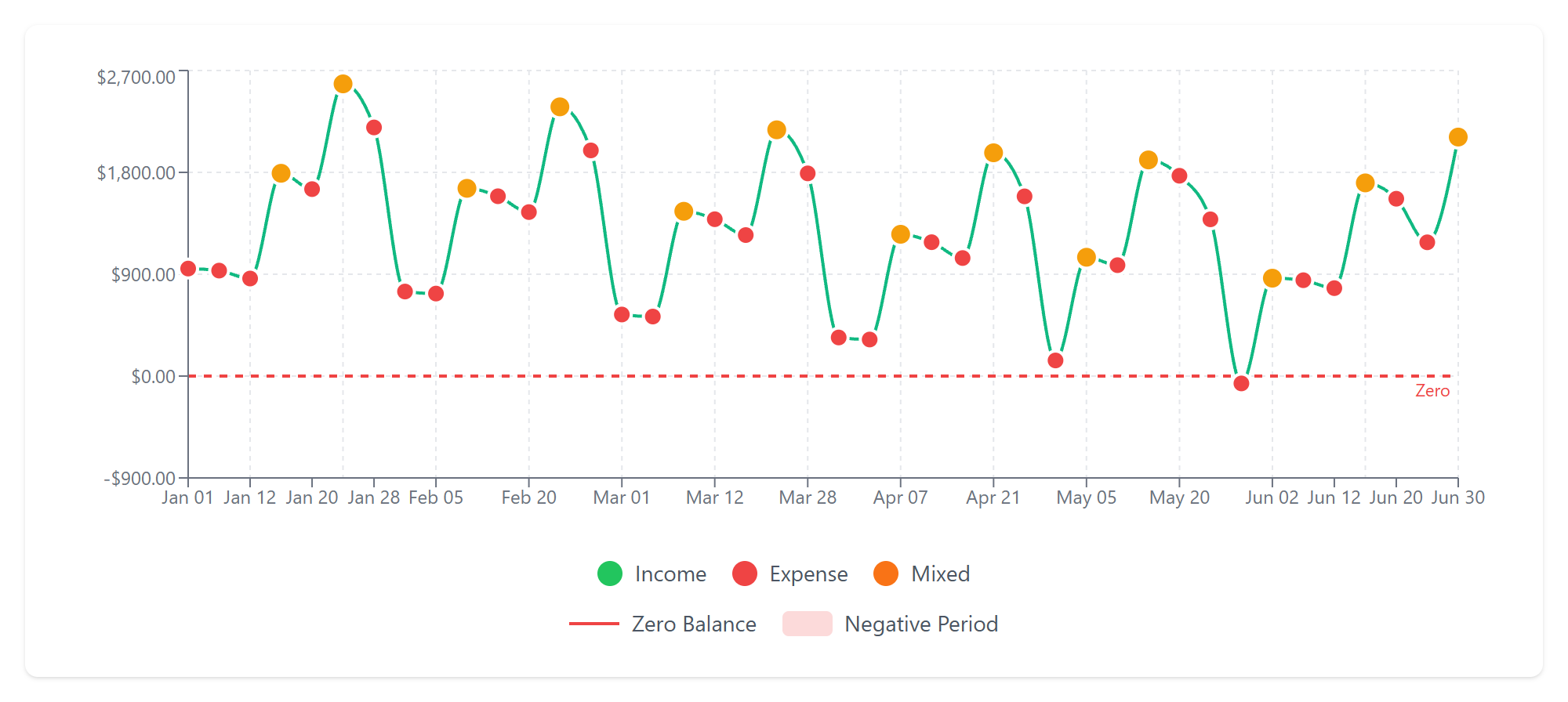
Nothing about June is unusual. The paychecks in May came on the 5th and the 19th. By June 1 the account has been paying bills for two weeks with nothing coming in. The dip was always going to be there. The forecast just shows it in January instead of June.
Three ways to fix it
- Move the due date. Most landlords, lenders, and insurers will move a due date if you ask. The trick is to move it to the middle of your pay cycle, not a few days later. In this example, rent on the 5th clears June but the dip comes back on October 5. Rent on the 15th never gets within $600 of zero all year.
- Hold back part of one transfer. On the payday before the dip, move less to spending. Here, $200 less on May 19 lifts June 1 from $65 under zero to $135 above it. Put the smaller transfer in the forecast first and check that the line holds.
- Trim the regular transfer. If the dip comes back every few months, the transfer is too big and the low point is telling you by how much. Here, $470 instead of $500 keeps the lowest point at $235 on June 1 and never lower all year. That $235 is the buffer, and the line sized it.
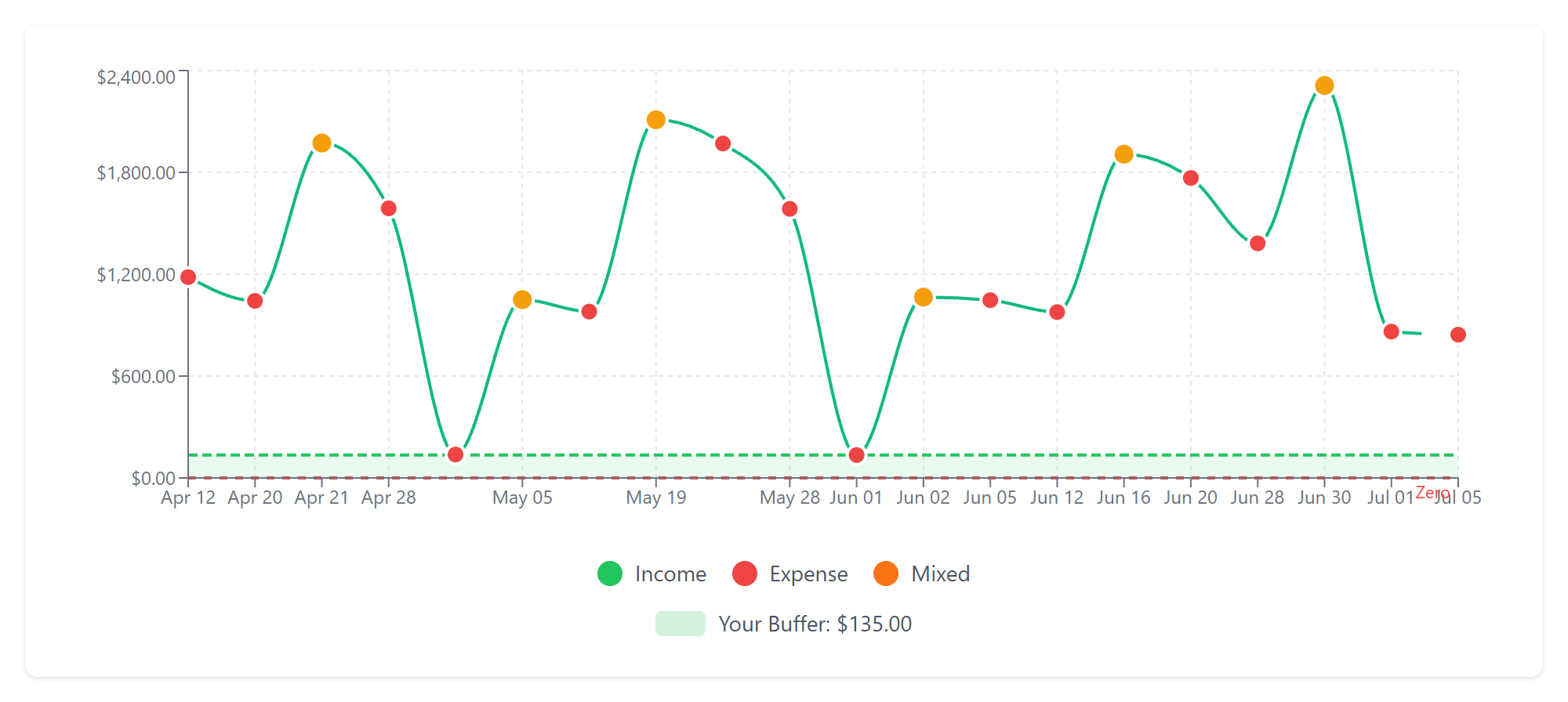
The first two fixes handle one dip. The third fixes the pattern. Use whichever matches what the line shows: a single red dip wants a one-time hold back, and a dip that repeats wants a smaller transfer.
What not to do
Don’t pay the bill late and eat the fee. A $35 late fee on a timing problem is paying for information you could have had for free.
Don’t move the bill to a credit card to buy time, unless you already pay the card in full. The dip doesn’t go away, it moves to the card’s due date, usually with interest attached.
And don’t solve it by keeping an extra thousand in the account “just in case.” That works, but it’s money sitting idle because you didn’t know the real number. The low point is the real number. Keep that much and a little more, and spend the rest.
Where SpokenFor fits
SpokenFor draws this line from your balance, your paychecks, and your bills, and marks the low point. A bill due before payday shows up under the zero line weeks ahead. The fix is one edit instead of a scramble. See your line.